When my daughter, Nora, was just really getting into solid foods, she tried essentially anything and everything. Naturally, I was so proud my child was a “good eater,” unlike myself as a kid who strictly ordered ketchup with French fries (not the other way around) at restaurants.
At that stage, we were experimenting with a ton of foods, from beets and black beans to chicken and carrots. At one point, when I somewhat arbitrarily felt it was safe for her to eat round foods, blueberries were introduced—she was soon hooked.
Eventually Nora’s devotion to blueberries starting spiraling out of control and she would refuse to eat pretty much anything else—with the exception of at daycare, of course, where they do some sort of Jedi mind trick to make the kids actually eat what they’re given.
So much for my esteemed good eater.
I was buying up to three pints of blueberries a week. At parties, my husband and I would sheepishly pick the scant blueberries out of the fruit salads, leaving the rest of poor kids to eat the cantaloupe. We had created a blueberry fiend. My only consolation was the fact that they’re actually good for her and her digestive tract was seriously healthy.
Months, and gallons of blueberries later, out of the blue Nora declared, “Sometimes I like blueberries, sometimes I don’t.” My jaw hit the floor. That was the beginning of the end of The Blue Period. Her consumption has dropped to less than a pint a week and some weeks she refuses to eat them at all.
Nora’s love for and eventual disinterest in blueberries followed the conventional Product Life Cycle to a tee. Almost all new products progress through this sequence of four stages: from introduction to growth, maturity, and decline. The cycle is associated with changes in the marketing situation, which in turn impacts the marketing strategy and the marketing mix.
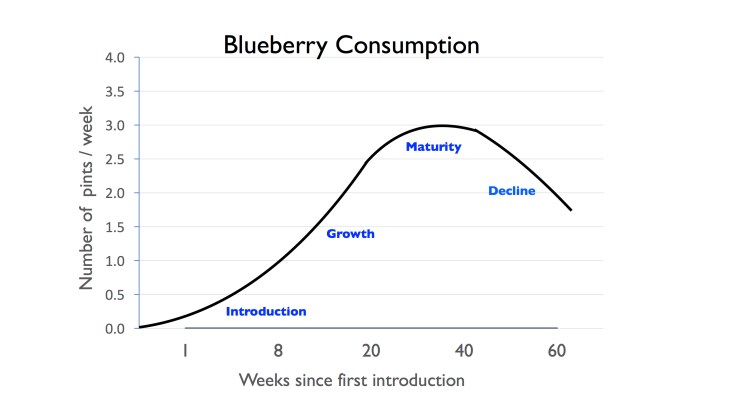
Introduction – The stage in which the product (blueberries) has been introduced for the first time in the market (my daughter) and the sales (consumption) of the product starts to grow slowly and gradually.
Growth – The product is present already in the market, the consumers of the products are habitual users of the product and there is quick growth in the product sales. In this example, the point at which a couple packages of blueberries were an unquestionable staple on my weekly grocery list.
Maturity – Sales (blueberry consumption) are near their highest, but the rate of growth is slowing down due to factors, such as new competitors in market, saturation or, most likely in this case, product fatigue.
Decline – The final stage of the cycle when sales begin to fall (e.g. the “sometimes I like blueberries, sometimes I don’t” stage).
Of course, the product life cycle can be extended through a variety of tactics, such as advertising, adding new features to a product or changing customer consumption habits. My real-world example of the latter is adding blueberries to fruit smoothies so my daughter still gets some of her superfoods.
So if you’ve been spending countless sleepless nights contemplating the potential relationship between blueberry consumption and the theory of a product life cycle, you may now rest easy.
 Marketing Like a Mother